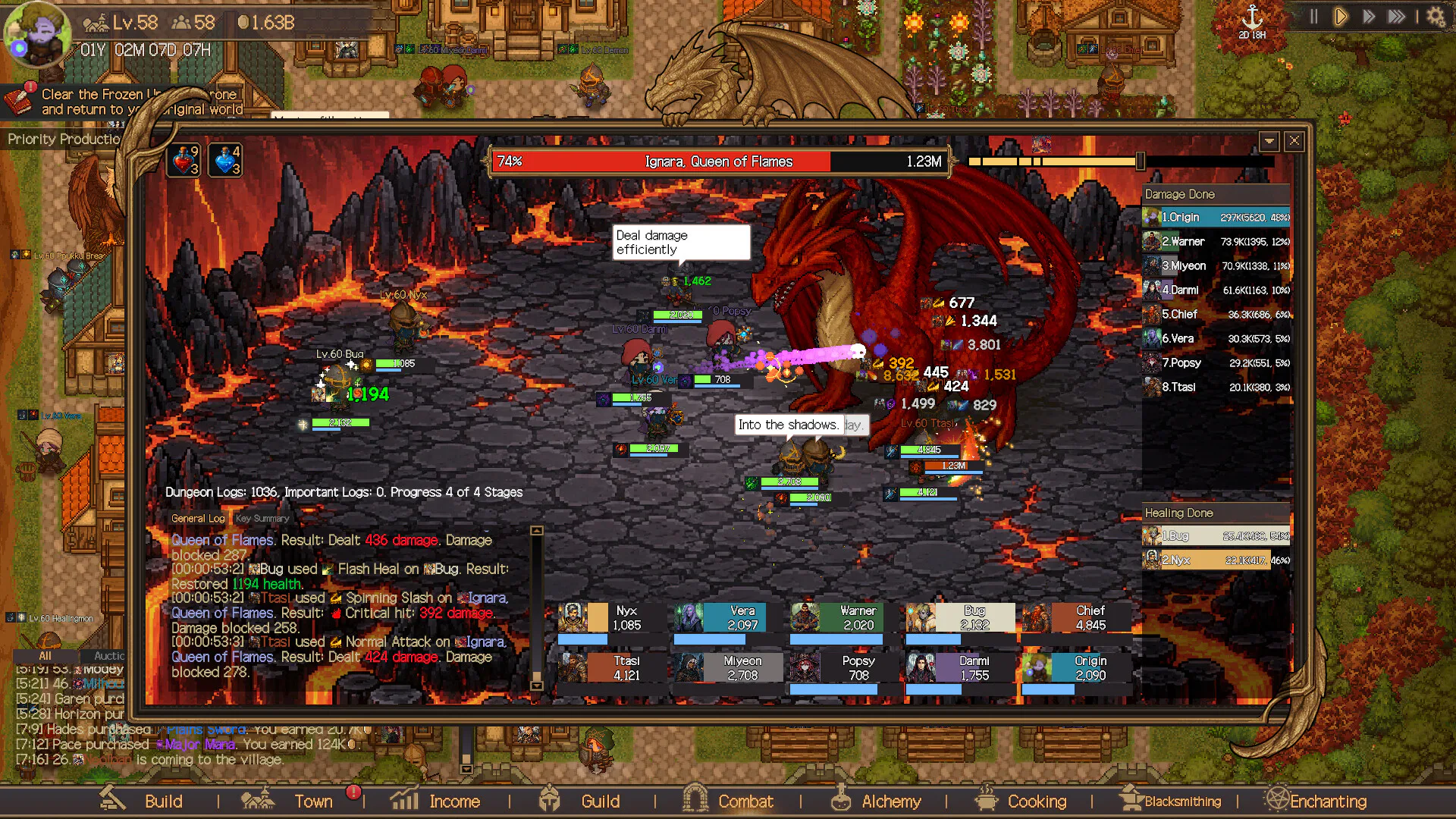
Prepare before committing a party
The game lists 19 standard dungeons and seven raids, so expedition progress is a campaign rather than a single difficulty ladder. Before entering, confirm the objective, party capacity, current equipment, and the roles supplied by each member. A balanced group needs a way to survive pressure and enough focused output to finish the task; the exact combination can change with the members and skills available to you.
Make only a few changes between attempts. Replacing half the team, crafting several items, and changing strategy at the same time makes the result hard to interpret. Adjust the clearest weakness first, then use the next run to see whether that weakness moved.
Name the failure before buying the solution
A failed run is useful evidence. If the party collapses quickly, check protection, recovery, and whether fragile members are exposed. If it remains safe but stalls, inspect damage roles, skill interactions, and target selection. If performance is inconsistent, simplify the lineup and test it in familiar content before spending rare materials.
This diagnosis keeps town production connected to a real need. You can ask the forge for a missing equipment improvement, the alchemy or cooking chain for expedition support, or the training system for a specific skill gap. Broad upgrading feels productive, but a focused correction gives clearer value from limited resources.
Repeat a dungeon with a defined purpose
Repeat runs make sense when you know what reward supports the next step. Choose a target, identify the member or facility that will use it, and decide how many runs the upgrade deserves. The Griffin Landing supports automated expedition activity, but automation is still most useful when attached to a deliberate material plan.
Review results instead of treating every completed run as progress. If the reward is no longer needed, redirect the party. If a lineup is reliable, record its roles so you can rebuild it after experimenting. This small habit prevents a successful composition from disappearing inside a rapidly growing roster.
Scale into raids in stages
Raids expand the organization problem with groups of 10, 12, or 15 guild members and distinct bosses and rewards. Do not wait until a raid unlocks to think about depth. Develop a proven core party, a second group with clear responsibilities, and reserves that cover missing roles. Equipment quality matters, but so does knowing why each member is present.
Use standard dungeons to test pieces of the larger plan. Familiar encounters expose whether a secondary group can function without borrowing every strong member from the core. When the raid becomes available, combine tested units and refine the edges rather than assembling the full roster from scratch.
Use a four-step expedition routine
First, define the reward or quest objective. Second, select members whose roles answer the expected challenge. Third, check equipment, skills, and consumable support. Fourth, review the outcome and change one major variable. This routine works for a new dungeon, a repeat run, or raid preparation because it keeps the decision tied to visible evidence.
The aim is not to find one universal party for all 26 major combat locations. Creator Chronicles gives the roster enough breadth for adaptation. A reliable player process is more valuable than a fixed tier list: understand the goal, build a suitable team, learn from the result, and feed that lesson back into recruitment, training, crafting, and town growth.